From Novi to Next Steps: Turning Collaboration into Impact


Share


More than 150 attendees joined us in Novi, Michigan, for COVESA’s Fall All Member Meeting. It was my first AMM as Executive Director, and an opportunity to experience in person what makes this such a strong community: the willingness of professionals and leading experts from across the automotive and mobility ecosystem to share expertise, challenge assumptions, and work together on problems no single organization can solve alone.
A central theme across the business sessions, technical working groups, and member conversations stood out: how are we working to translate collaboration into practical business value? Here are five key takeaways from Novi and what they mean for the work ahead of us.
1. Collaborate on the foundations. Compete on what makes us different.
One of the most useful questions of the week was where companies should build together and where they should differentiate. As software-defined vehicles become more complex, common interfaces, data models, and reusable capabilities can reduce duplicated engineering effort while leaving room for innovation in products and customer experiences.
That theme ran through sessions such as “From Going It Alone to Building Together: The Business Case for an Open SDV Ecosystem” and “Open to Scale: Turning SDV Collaboration into Commercial Value.” For members, the opportunity is concrete: focus shared investment on challenges that benefit from industry alignment, and preserve resources for the capabilities that distinguish their businesses.
2. Vehicle data creates more value when it can move across use cases.
Work across the Vehicle Signal Specification (VSS), Vehicle Data Model (VDM), and commercial and fleet vehicle initiatives demonstrated why interoperability matters beyond the technical specification itself. Common approaches to vehicle information can make it easier to connect systems, reuse solutions, and support applications across manufacturers and service providers.
Sessions on VSS and VDM evolution, commercial vehicle fault codes, and the first results of COVESA’s cooperation with ACEA showed the range of this work. For members, the next question is how these outputs translate into implementations, useful tools, and clearer pathways to adoption—not simply how much technical work has been completed.
3. Digital trust is becoming a practical vehicle and customer need.
The session featuring Manu Sporny of Digital Bazaar and Ted Guild of Geotab on the COVESA–California DMV collaboration offered a particularly useful example of how standards work can connect to everyday needs. Their discussion of digital identity and verifiable credentials showed why trustworthy, interoperable information matters for vehicles, drivers, and the organizations serving them.
The near-term potential is practical: digital proof of vehicle identity, insurance, or eligibility could make registration, fleet operations, inspections, and related transactions easier to manage. For automotive customers, that could mean fewer manual steps, less paperwork, and more control over the information they share.
The broader implication is significant: a trusted foundation for exchanging vehicle and driver information could support use cases spanning commercial fleets, passenger vehicles, insurance, regulatory compliance, and connected services and ultimately benefit companies and the customers they serve. The value will ultimately depend on implementation and adoption, which is where COVESA members play a key role. Learn more and get involved here.
4. Measure success by adoption and business outcomes—not activity alone.
Novi reinforced the importance of starting with shared industry problems, then connecting technical work to outcomes members can measure. Progress is not just a specification published or a meeting held. It is whether an output is adopted, reduces duplicated engineering effort, improves quality, shortens development cycles, or helps a company bring a better product to market.
Sessions on the AOSP App Framework, in-vehicle payments, connected safety, and the Connected Vehicle Emergency Dataset illustrated different stages of the journey from shared ideas to useful implementations. We have an opportunity to make the maturity of each effort, its intended users, deliverables, and paths to adoption clearer. AI also creates possibilities for helping engineers discover standards, generate implementation examples, and lower the learning curve—areas to explore thoughtfully, with appropriate safeguards rather than promise prematurely.
5. Members will define our next chapter.
As a member-led organization, your priorities define COVESA’s priorities. Some of my most meaningful conversations happened between sessions. Members come to COVESA with different goals: solving a technical problem, influencing an industry approach, connecting with peers, testing an emerging application, or identifying opportunities for their business. The value of participation should be clear and getting involved should be easy.
That thinking is central to our work to strengthen the member experience. We’re working to actively seek broader member input on shared industry challenges and the value of current projects, improving onboarding and engagement pathways, and making it easier for both business and technical leaders to find relevant opportunities. We also want to better connect emerging market issues to practical, collaborative work. If you’d like to learn more, get involved, or share your input, I’d love to hear from you. You can reach me at jstenberg@covesa.global.
COVESA Awards
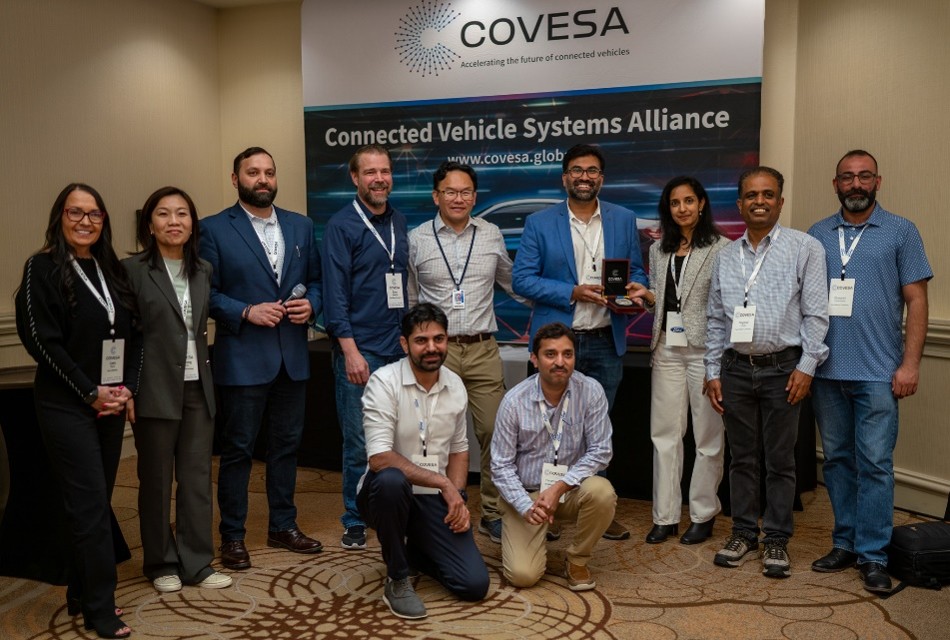
Congratulations again to Ford and HAAS Alert, our 2026 COVESA Adopter & Contributor Award recipients. These awards recognize the organizations helping turn shared standards and collaborative work into real-world adoption and meaningful contributions to the COVESA community. Their work reflects the impact we want to continue building across the ecosystem.
What’s Next
As we look toward 2027, our direction is clear: sharpen the connection between industry needs and technical priorities, make real-world use cases and implementation resources easier to find, and help members understand how to participate and benefit to increase the collective value for members and the broader connected vehicle ecosystem.
Thank you to our members, attendees, Board of Directors, speakers, sponsors, industry partners, and the COVESA team for a valuable week in Novi. I left my first AMM encouraged by the expertise and openness of this community and excited about the meaningful work ahead of us. We look forward to seeing you in January at CES for our Networking Reception and Demonstration Showcase, and be sure to mark your calendar for the 2027 Spring AMM taking place May 19-20, 2027, in Munich!
Explore the Fall AMM presentations and photos
Over the next week, we’ll be highlighting presentations from the meeting. You can access the presentations at: COVESA 2026 Fall AMM presentations.
ABOUT
The Connected Vehicle Systems Alliance (COVESA) is an open and member-driven global technology alliance accelerating the full potential of connected vehicles and the mobility ecosystem. As the only alliance focused solely on developing open standard approaches and technologies for connected vehicles, COVESA serves as a collaborative platform that brings together automotive software stakeholders with world-class developers to address opportunities and challenges in the automotive industry and navigate the digital transformation shaped by customer expectations.
To learn more about COVESA or to join our community, visit www.covesa.global.
Related Pages
Organizations interested in joining the Alliance as active members can learn more at www.covesa.global/join.