
Scaling Vehicle Data Innovation: A CVED Proof of Concept
How the Connected Vehicle Emergency Dataset (CVED) Project will provide a standardized API for accessing connected safety Vehicle Signal Specification (VSS) data, transforming an airbag from a passive restraint into an active 9-1-1 emergency participant.



Share


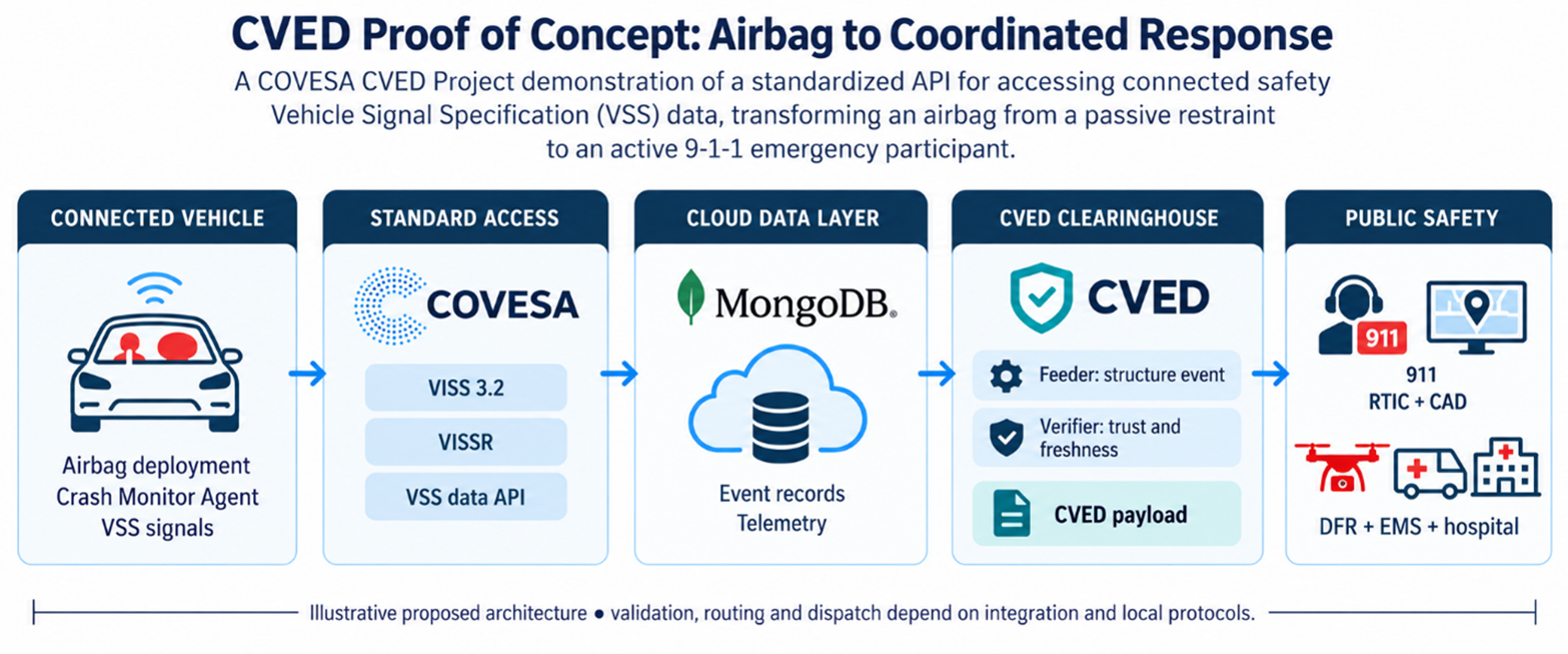
Authors: Ulf Björkengren, Ford; Rami Pinto, MongoDB; Lawrence Williams, LiDAR Saving Lives (LSL) Public Safety Coalition; Tim VanGoethem, Emergency Safety Solutions (ESS)
As connected vehicles become increasingly software-defined, the automotive industry has an opportunity to rethink how vehicle data can contribute to public safety. One of the most compelling examples is an event that occurs millions of times across vehicle lifecycles but remains largely disconnected from real-time emergency response systems: airbag deployment.
Today’s airbags are extraordinarily sophisticated safety devices. Yet the information generated when an airbag deploys often must travel through telematics intermediaries, voice-based communications, and other processes before it becomes actionable intelligence for emergency responders.
What if an airbag deployment could become a trusted digital event, automatically communicating critical crash information to a 9-1-1 Real Time Intelligence Center (RTIC) within seconds?
A proposed collaboration involving Ford, MongoDB, and the LiDAR Saving Lives Public Safety Coalition is exploring this opportunity through the COVESA Connected Vehicle Emergency Dataset (CVED) initiative.
At the COVESA All Member Meeting (AMM), October 28–29, 2026, in Novi, Michigan, the collaborators plan to demonstrate a proof-of-concept architecture connecting standardized vehicle signals to cloud-based emergency data processing and public-safety workflows.
Extending VISS Innovation into Connected Safety
COVESA’s Vehicle Signal Specification (VSS) establishes a common vocabulary for describing vehicle signals. Its companion Vehicle Information Service Specification (VISS) provides a standardized API for accessing those signals across different vehicle architectures and connected services.
Recent VISS 3.x developments, including support for multiple data trees, additional transport options, and schema-based validation, provide greater flexibility for automotive software developers.
The VISSR reference implementation enables these capabilities to be explored through running software.
Ford and MongoDB have been exploring the cloud integration of VISS-based telemetry through a fleet-monitoring proof of concept. This work illustrates how standardized vehicle data can be transported into a document-oriented cloud environment for scalable storage, retrieval, and processing.
The CVED initiative proposes extending this architectural approach from continuous fleet telemetry into a particularly time-sensitive application: the moment a vehicle detects an airbag deployment.
Unlike traditional fleet monitoring, connected safety requires more than collecting and analyzing vehicle data. It requires transforming a safety-critical event into an authenticated, structured, time-sensitive notification that authorized emergency response systems can consume.
From Vehicle Signals to a Connected Vehicle Emergency Dataset
The proposed CVED Project will define a standardized emergency dataset and exchange format for vehicle-originated incidents, beginning with airbag deployment.
Rather than requiring every automotive manufacturer and public-safety technology provider to develop proprietary integrations, CVED aims to establish a common data contract that can be used across vehicle platforms, cloud services, and emergency response applications.
An initial CVED event could include airbag deployment status, geographic location, event timestamp, available occupant and seat information, vehicle attributes, and other relevant crash telemetry.
A vehicle-resident Crash Monitor Agent would detect the event and obtain the relevant signals through the standardized vehicle data interface.
The resulting information would be processed into a CVED-compatible incident record, preserving its source, event identity, and relevant contextual information.
This approach offers a path toward interoperability between software-defined vehicles and the emerging generation of 9-1-1 RTICs.
Connecting Vehicle Data to Emergency Response Through the Cloud
The proposed architecture combines three complementary capabilities.
COVESA vehicle data standards provide the foundation for accessing and interpreting vehicle signals through VSS and VISS.
MongoDB’s document-oriented cloud technology provides an example of how heterogeneous vehicle telemetry and emergency event records can be represented, managed, and made available to downstream applications.
The LiDAR Saving Lives Public Safety Coalition’s connected safety initiative brings the emergency response use case, CVED data requirements, and proposed integration with public-safety RTIC and Computer-Aided Dispatch (CAD) workflows.
An important architectural element is the proposed Airbag Deployment IoT Clearinghouse, which introduces two complementary functions.
The Feeder receives vehicle-originated crash telemetry, maps the available information into a structured CVED event, and prepares it for delivery to an authorized RTIC/CAD endpoint.
The Verifier evaluates source authenticity, data validity, event freshness, and potential duplicate or replayed events before the incident is accepted for downstream operational use.
Together, these capabilities are intended to make crash information not merely accessible, but trustworthy, traceable, and actionable.
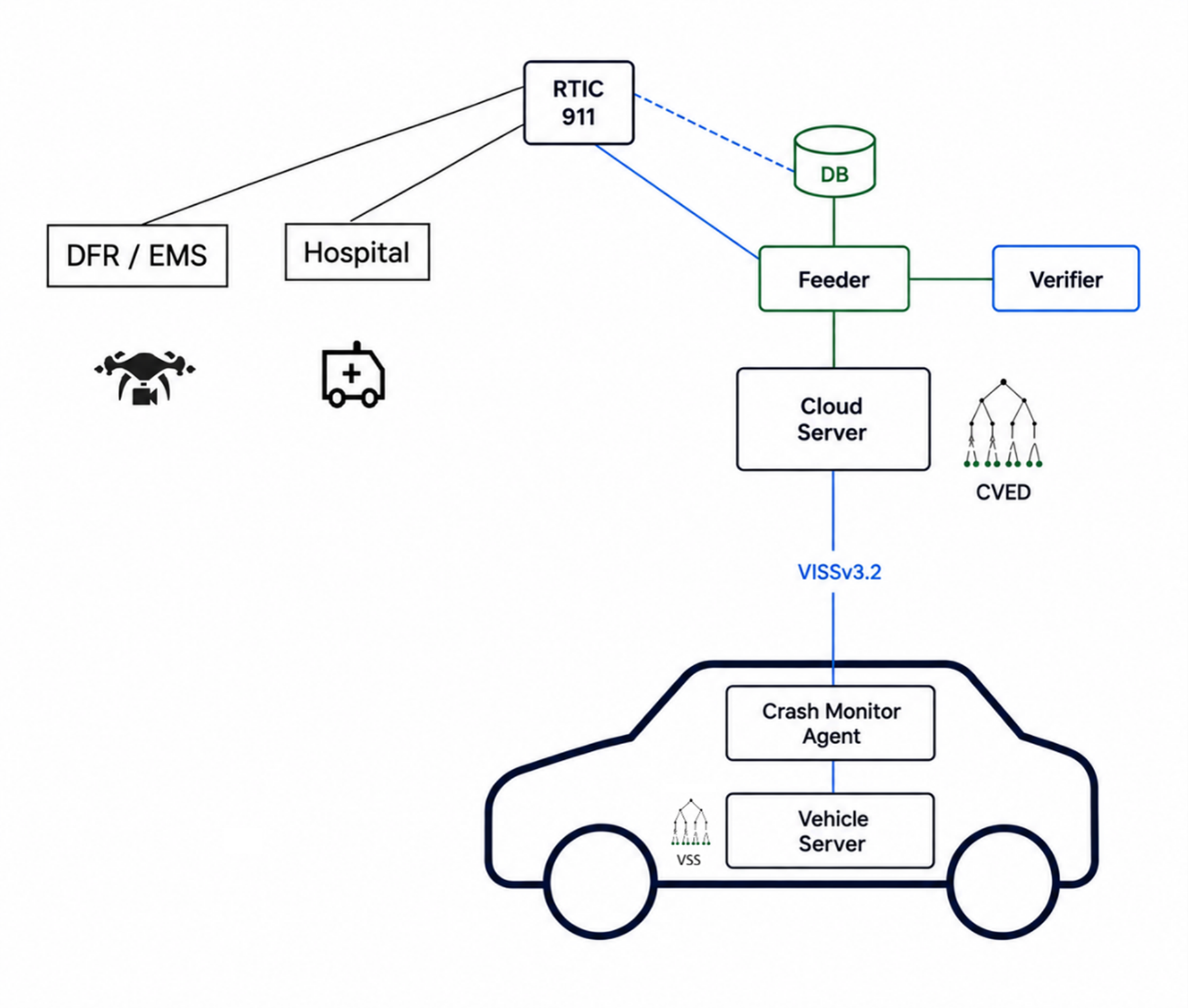
Figure 1. Proposed CVED Proof-of-Concept Architecture
The architecture illustrates how airbag deployment could initiate a machine-to-machine emergency data workflow.
When the vehicle’s Crash Monitor Agent detects airbag deployment, it accesses relevant vehicle VSS data, which is used to create a CVED-based message that is then transmitted into a cloud environment. MongoDB provides the proposed document-oriented data layer for managing event information.
The CVED processing layer structures the event and applies appropriate verification checks before delivering it through an authorized public-safety interface.
A receiving RTIC/CAD system could then support coordinated decisions involving 9-1-1 dispatchers, Drone First Responders (DFRs), Emergency Medical Services (EMS), and hospital trauma teams.
Importantly, this digital workflow is intended to complement established emergency call handling, dispatch authority, and local response protocols – not replace them.
Making the Seconds After a Crash Count
A defining objective of the CVED proof of concept is to explore how quickly a vehicle-originated emergency event can become usable information within a public-safety system.
The proposed demonstration targets a 2–3-second interval from airbag deployment to acknowledgement of a verified event by the receiving RTIC/CAD system.
This is a performance objective to be measured, not an established result.
The demonstration architecture provides an opportunity to examine event detection, transmission latency, data transformation, verification, and receiving-system acknowledgement as separate measurable steps.
It also creates a framework for testing exceptional conditions, including unavailable vehicle signals, invalid credentials, duplicate notifications, and interrupted network connectivity.
Success would represent more than faster data transmission. It would demonstrate how common vehicle data standards could support a repeatable, measurable workflow connecting automotive safety systems to emergency response infrastructure.
Beyond the Airbag: A Foundation for Connected Safety Innovation
Airbag deployment represents a compelling initial use case because it is a discrete, safety-critical event generated directly by the vehicle.
However, the longer-term opportunity is broader.
A standardized CVED architecture could provide a foundation for additional connected safety applications involving crash severity assessment, vehicle submersion, fire detection, emergency vehicle interactions, and other vehicle-originated incidents.
It could also support more sophisticated coordination between vehicle manufacturers, public-safety agencies, drone operators, emergency medical providers, and hospitals.
The key is establishing common interfaces and trustworthy data exchange mechanisms that allow these systems to communicate without requiring an entirely new proprietary integration for each application.
Join Us at the COVESA All Member Meeting
At the October 28–29 COVESA All Member Meeting in Novi, Michigan, Ford, MongoDB, and the LiDAR Saving Lives Public Safety Coalition plan to share the CVED proof-of-concept architecture and discuss how the COVESA community can contribute to its development.
The discussion will focus on the evolving CVED data model, VSS/VISS integration, cloud-based event processing, verification requirements, and RTIC/CAD interoperability.
Participation from automotive OEMs, vehicle software developers, cloud technology providers, emergency communications specialists, public-safety agencies, and Drone First Responder program operators will be particularly valuable.
The opportunity is to move beyond connecting vehicles to the cloud and begin connecting vehicles directly to the systems responsible for saving lives.
Get Involved!
Learn more about the COVESA Vehicle Signal Specification (VSS), Vehicle Information Service Specification (VISS), and Connected Safety initiatives.
Join the discussion at the COVESA All Member Meeting, October 28–29, 2026, in Novi, Michigan, and help shape the future of standardized vehicle-originated emergency communications.
About the CVED Project
The proposed COVESA Connected Vehicle Emergency Dataset (CVED) Project aims to define a standardized data model and exchange format for communicating safety-critical vehicle events to authorized public-safety systems.
Building upon COVESA VSS and VISS capabilities, the initiative seeks to enable interoperable, machine-to-machine emergency notifications between connected vehicles, cloud services, and 9-1-1 Real Time Intelligence Centers.
Its initial focus is airbag deployment, with the broader objective of enabling trusted vehicle data to support faster, better-informed emergency response.
To learn more about COVESA or to join our community, visit www.covesa.global.